Seasons
Uyuni weather month by month: temperature, rain, mirror
· 7 min read
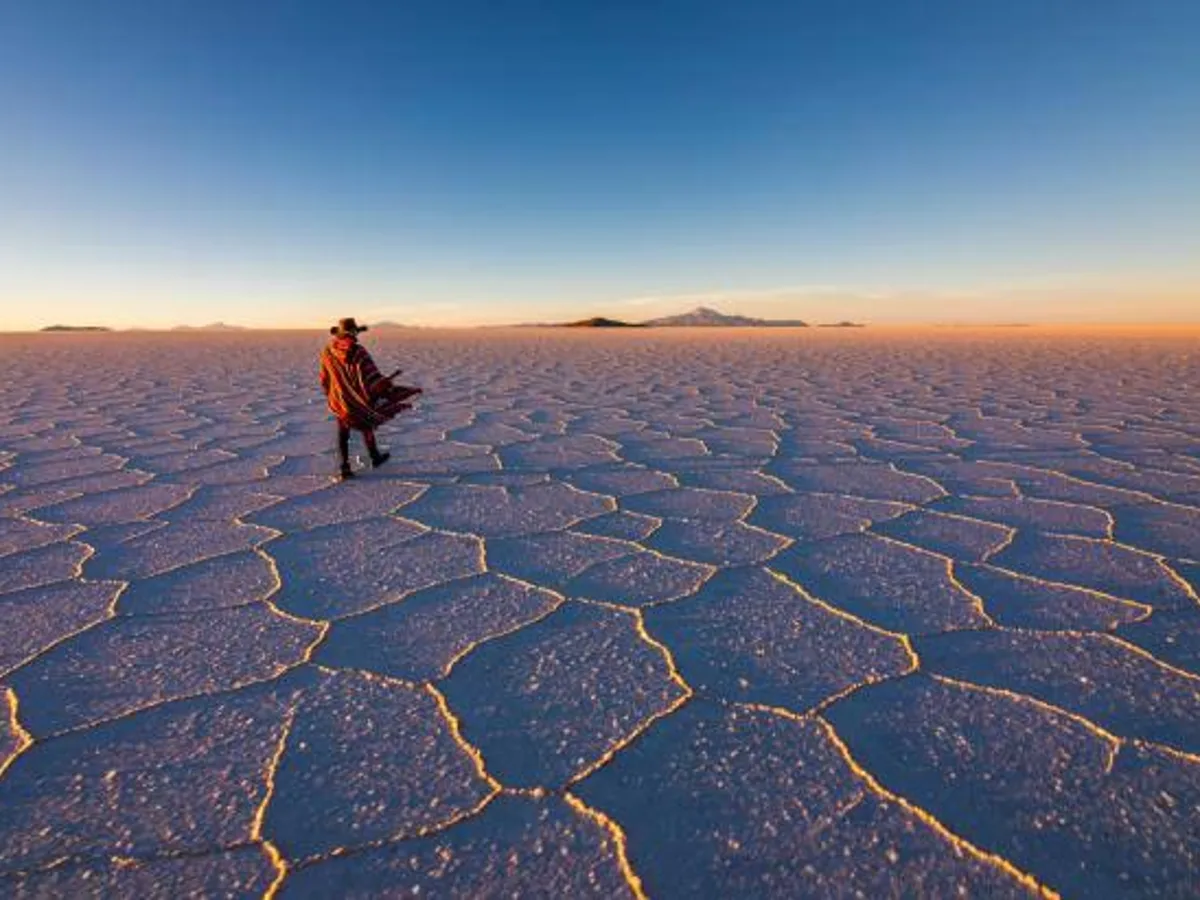
Uyuni is dry, sunny and cold for most of the year. Daytime highs run from about 13 °C in June and July to 21 °C in summer, but nights drop below freezing from April to October, to around −10 °C on average in midwinter. Nearly all of the 190 mm of annual rain falls from December to March, and that rain is what makes the mirror effect, most reliable in January and February.
Uyuni temperatures and rainfall, month by month
The figures below are the official 1981 to 2010 averages for the town of Uyuni, at about 3,670 m, from SENAMHI, Bolivia’s national weather service. The salar lies at almost the same altitude, so they hold for a day on the salt. The second and third days of the 3-day route run 700 to 1,300 m higher and are noticeably colder. The last column is what the salt usually looks like that month: a tendency, not a forecast, since the mirror depends on how much rain has fallen in the days before.
| Month | Average high | Average low | Rain | Rainy days | On the salar |
|---|---|---|---|---|---|
| January | 21 °C | 6 °C | 79 mm | 11 | Mirror most likely |
| February | 20 °C | 5 °C | 38 mm | 7 | Mirror most likely |
| March | 20 °C | 3 °C | 29 mm | 6 | Mirror possible |
| April | 19 °C | −1 °C | 2 mm | 1 | Drying out, mirror unlikely |
| May | 15 °C | −6 °C | 1 mm | <1 | Dry white crust, no mirror |
| June | 13 °C | −10 °C | 2 mm | 1 | Dry white crust, no mirror |
| July | 13 °C | −10 °C | 0 mm | 0 | Dry white crust, no mirror |
| August | 15 °C | −8 °C | 2 mm | <1 | Dry white crust, no mirror |
| September | 17 °C | −5 °C | 2 mm | <1 | Dry white crust, no mirror |
| October | 19 °C | −3 °C | 3 mm | <1 | Dry white crust, no mirror |
| November | 21 °C | 0 °C | 4 mm | 1 | Dry white crust, no mirror |
| December | 21 °C | 3 °C | 26 mm | 4 | Mirror possible |
Two things in that table explain most of what travellers get wrong. The first is the daily swing: in the dry months there are 20 to 23 degrees between the warmest hour of the afternoon and the coldest hour of the night. The second is what averages hide. The lowest temperature on record at Uyuni is −25.7 °C, measured in August, and a cold snap can push a July night well below the −10 °C mean.
How cold does it get on the 3-day tour?
Colder than in town, and the second night is the reason. Our route spends the first night in a salt hotel in Colcha K, a village at roughly 3,750 to 3,800 m, and the second in a simple shared lodge beside the Polques hot springs, at about 4,400 m, which is basic and cold. On a July night up there, temperatures far below the town’s −10 °C average are normal, and lows around −20 °C are reported. Thermal layers, a hat and gloves are not optional for that night in the dry season.
Daytime is a different story. Above 4,000 m the sun is fierce whenever it is out, and in a sheltered spot at midday it is often warm enough to take off a layer, then cold again the moment the wind gets up. Dressing in layers you can add and remove in a minute is the whole technique.
The three seasons that matter on a salt flats tour
- December to March, wet and mild. Highs around 20 °C, lows of 3 to 6 °C, afternoon storms, and the mirror effect whenever water lies on the crust. Incahuasi Island is often unreachable in January and February; the details are in our guide to the rainy season.
- April to August, dry and cold. Clear skies on almost every day, the hexagonal salt tiles at their sharpest, full access across the flat, and the coldest nights of the year: June and July average −10 °C in town. The best months for starry skies, if you can face standing outside to see them.
- September to November, dry and warming. Nights ease from −5 °C towards freezing, days reach 17 to 21 °C, and the wind tends to be at its strongest. A good compromise if you want the whole salar without the deepest cold.
What time is sunset on the Uyuni salt flats?
Uyuni lies about 20° south of the equator, so day length changes less than in Europe or North America, but enough to matter for a sunset tour. Around the June solstice the sun rises at about 07:00 and sets just before 18:00. Around the December solstice it rises before 06:00 and sets a little after 19:00. That is why our 1-day tour is back in town around 19:00 in winter and 20:00 in summer: it stays out on the salt for sunset in both seasons.
Wind, sun and dust
Wind is the part of Uyuni weather that averages do not show. It usually builds through the afternoon, and on the open salar there is nothing to stop it. From August to October it can be strong enough to lift dust and salt off the tracks and to turn a mild afternoon into a cold one. A windproof layer and a buff or scarf do more than a heavier coat.
The sun is the opposite problem. The World Health Organization puts the rise in UV at roughly 10% for every 1,000 m of altitude, and the white salt reflects it back up from below, so people burn under the chin and on the ears even on a cool day. Sunglasses are essential on the salar in every month of the year.
What the weather means for your dates
If you want the reflection, the weather decides for you: January and February, accepting rain and perhaps no Incahuasi. If you want hard white salt, the island and the perspective photographs, anything from May to November works, and the choice is between the clear skies and deep cold of June and July or the milder, windier spring. On the 3-day tour, the second night is the coldest part of the trip in every season, so pack for it with our packing list for Uyuni.
Our prices do not change with the season. Departures in 2026 cost $79 per person in a shared 4x4 for the 1-day tour and $239 for the 3-day tour; from 1 January 2027 the 1-day tour stays at $79 and the 3-day tour is $269. You can see availability and book online.
Frequently asked questions
- What is the coldest month in Uyuni?
- July, closely followed by June. Average lows in town are about −10 °C, with daytime highs around 13 °C. The lowest temperature on record at Uyuni is −25.7 °C, measured in August. Nights on the 3-day route, above 4,000 m, are colder still.
- How warm is it on the salt flats during the day?
- Between about 13 °C in June and July and 21 °C from November to January, according to SENAMHI averages for Uyuni. The sun is strong at 3,660 m, so it feels warmer in still air and much colder in the wind.
- Which months are dry in Uyuni?
- April to November. Those eight months together receive around 15 mm of rain on average, less than a fifth of what falls in January alone.
- When is the rainy season at the Uyuni salt flats?
- From about December to March, when almost all of the 190 mm of annual rain falls. January is the wettest month, with around 79 mm over 11 rainy days on average. That water creates the mirror effect, most reliably in January and February, and often cuts off Incahuasi Island.
- What is the weather like at Uyuni in November?
- Dry, sunny and often windy. Average highs reach about 21 °C and lows about 0 °C, with around 4 mm of rain in the whole month. The salt is dry, so a mirror is unlikely, but the whole salar is open, Incahuasi Island included.
- How cold is it at night on the 3-day tour?
- The second night, at about 4,400 m by the Polques hot springs, is the coldest. In the dry season temperatures there fall well below −10 °C, and lows around −20 °C are reported in July. Thermal layers, a hat and gloves make the difference.
- What time is sunset at the Uyuni salt flats?
- Just before 18:00 around the June solstice and a little after 19:00 around the December solstice, Bolivian time. Tours that stay for sunset on the salar come back to Uyuni later in summer than in winter for that reason.