Planning
When to see the mirror effect on the Uyuni salt flats
· 6 min read
The mirror is not a permanent feature of the Salar de Uyuni. It exists for a few months a year, it depends on centimetres of water, and chasing it costs you something else. Here is what actually governs it.
Why the salar turns into a mirror at all
The salar is the bed of a prehistoric lake, Lago Minchin, left behind when the Andes rose and the water evaporated. What remains is a salt crust of roughly 3 to 10 metres over some 10,500 km², sitting in a basin with no drainage outlet.
That last detail is the whole mechanism. Rain that falls on the salar cannot run off anywhere — it can only sit there and evaporate. And because the surface varies by less than a metre across its entire width, the water spreads as one continuous sheet instead of pooling. It is flat enough that satellites use it to calibrate their altimeters.
The months that actually work
The wet season runs from roughly November to April. But "wet season" and "mirror season" are not the same thing: the water needs time to accumulate, so the reflections build through the season rather than arriving with the first rain.
- January and February — the peak. Heaviest rainfall and the most consistent sheet of water. This is when the classic mirror photographs are taken.
- December and March — the shoulders. Real chances, less reliable. Often the best compromise if you also want to reach the island.
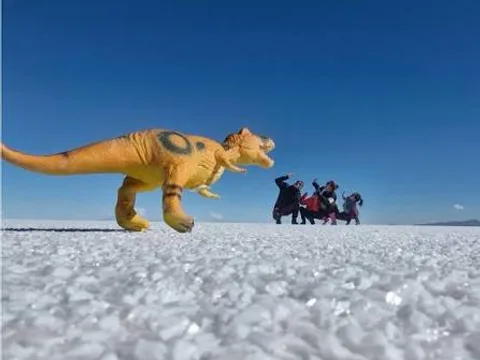
- May to October — the dry season. No mirror. Instead you get the hexagonal salt tiles, hard white ground in every direction, and full access across the flat.
It is a question of centimetres
The reflection has a narrow window. Somewhere around 2 to 5 cm of water gives the cleanest mirror. Below that, the water evaporates too fast or gathers in the low spots instead of covering the surface. Above roughly 20 cm, the slightest wind ripples it — and the vehicles can no longer cross safely.
This is why nobody can promise you a mirror. A guide can promise you the right months and the right corner of the salar; the rest is a rain gauge.
The trade-off: you lose Incahuasi
Incahuasi Island — the outcrop covered in giant cacti in the middle of the white — is reached by driving across the crust. When the salar floods, that drive stops being possible, and the island is regularly unreachable through the wettest months.
So the honest framing is not "when is the best time to visit Uyuni". It is: do you want the reflection, or do you want the island and the perspective photographs? Both are excellent. They are simply in different seasons.
The hour matters more than the month
Even in February, a mirror photographed at midday is disappointing: the sun is overhead, the light is hard, and the reflection flattens out. The hour after sunrise and the hour before sunset are what produce the images you have seen — the sky doubled, the horizon gone.
In the wet season, bring rubber boots — you will be standing in salt water. We rent them at the office in Uyuni for about 15 BOB if you would rather not carry a pair across South America.
Frequently asked questions
- What months have the mirror effect at Salar de Uyuni?
- January and February are the most reliable, with December and March as realistic shoulder months. The wet season overall runs from about November to April.
- Can you see the reflections in July?
- No. July is the middle of the dry season. You get the hexagonal salt tiles, guaranteed access to Incahuasi Island and the classic perspective photographs instead.
- Is Incahuasi Island open during the mirror season?
- Often not. Vehicles reach the island by driving over the salt crust, which is not possible when the flat is under water. Expect to miss it in January and February.
- How much water is needed for a good reflection?
- Roughly 2 to 5 cm. Less than that and the water pools or evaporates; more than about 20 cm and wind ripples the surface while vehicles can no longer cross safely.