Places
Laguna Colorada, Bolivia: red lagoon, flamingos and altitude
· 7 min read
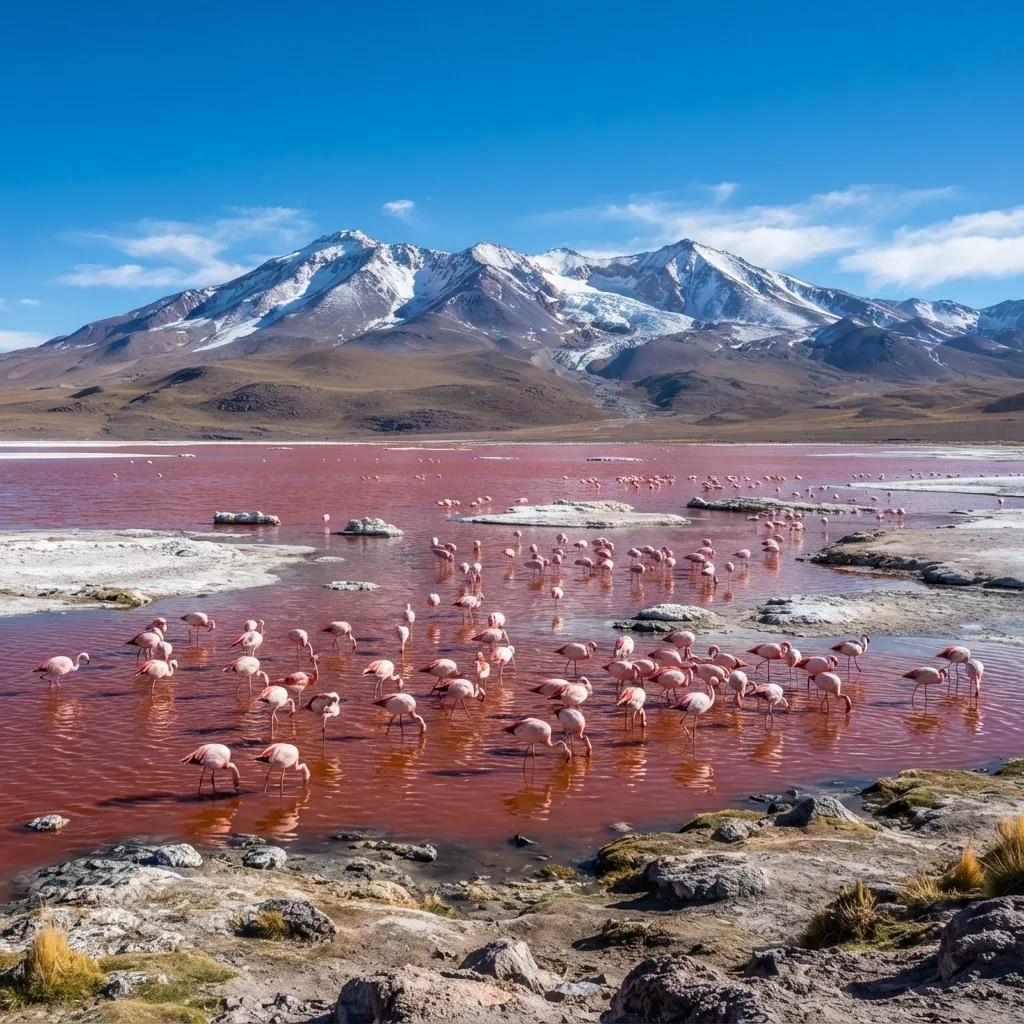
Laguna Colorada, Bolivia’s red lagoon, is a shallow lake at 4,278 m in the Eduardo Avaroa reserve, in the south-west of the country. It covers about 60 km² yet averages only 35 cm deep. Algae and red sediments colour it, and three flamingo species feed there, James’s flamingo above all. It is reached on the 3-day Uyuni tour, not in a day.
Where is Laguna Colorada?
In the far south-west of Bolivia, in the department of Potosí, not far from the Chilean border. It lies inside the Eduardo Avaroa Andean Fauna National Reserve, created in 1973 and covering 714,745 hectares between about 4,200 and 5,400 m. With some 153,000 visitors in 2018, the reserve is the most visited protected area in Bolivia, and the red lagoon is its best-known sight. The lake has also been listed as a Ramsar wetland of international importance since 1990.
There is no public transport to the lagoon, only dirt tracks across the altiplano. From Uyuni, tours take the long way round: the salt flat on day one, then south past the volcano viewpoints and the smaller lagoons. On our 3-day tour, Laguna Colorada comes on the afternoon of day two, after Lagunas Cañapa, Hedionda and Honda, the Siloli desert and the Árbol de Piedra. It cannot be done as a day trip from Uyuni, which is the real difference between the 1-day and 3-day tours.
Why is Laguna Colorada red?
Mostly because of what lives in it. The water is salty and shallow and carries dense populations of a microscopic alga, Dunaliella salina, whose pigments turn it anything from pale pink to brick red. Red sediments on the bottom add to the effect. The shade shifts with sunlight, temperature and wind, which stirs up the water, and many visitors find it reddest in the afternoon light, which is when most tours arrive. In softer light it can look pink rather than red, which is why some travellers call it the pink lagoon.
The white patches along the shore are not ice or salt. They are deposits of borax, a boron mineral, that form islands and banks across the lake. The flamingos come for food: algae and tiny organisms such as diatoms, which they filter out of the shallow water with their bills.
Which flamingos live at Laguna Colorada?
Three of the world’s six flamingo species. James’s flamingo is the most abundant here, and Laguna Colorada is one of its most important breeding sites in the region. It is a bird with a story: the species was believed extinct until a population was found in 1956.
| Species | How to recognise it | Worth knowing |
|---|---|---|
| James’s flamingo | Bright yellow bill with a black tip, brick-red legs, pale plumage | Thought extinct until 1956; the most numerous species here |
| Andean flamingo | Yellow legs; bill pale yellow at the base and black for most of its length; more black on the wings | Listed as Vulnerable on the IUCN Red List |
| Chilean flamingo | The largest of the three; pink plumage, and no yellow on the bill | Listed as Near Threatened on the IUCN Red List |
Bring binoculars if you have a pair. The birds feed spread out across the lagoon, often well away from the viewpoints, and telling the species apart by bill and leg colour is far easier through binoculars than on a phone zoom. For photographs, a long lens of 200 mm or more does the same job.
When is the best time to see the flamingos?
There are flamingos at Laguna Colorada all year, but their numbers change with the season and the water. The birds breed in the southern summer, from around November, and the wet months from December to April are often reported to bring the most of them. In the dry winter, the shallowest edges of the lagoons can freeze overnight and the birds gather on the open water. Any month gives you flamingos; none guarantees a particular number.
What is the best time of day at Laguna Colorada?
The afternoon, for most visitors. It is when the water usually looks its reddest, and it is when tours from Uyuni get there, ours included, after the smaller lagoons and the Siloli desert. The price is the wind: on the altiplano it usually builds after midday, ruffles the shallow water and makes the viewpoint cold. Mornings are calmer and colder, and in the dry season the shallow edges can still be frozen early on. To see the lagoon at sunrise you would have to sleep at one of the basic lodges near it rather than continuing to the hot springs.
Vehicles stop near the shore, and a short walk leads up to the viewpoint, the mirador, above the lagoon. It gives the classic view across the red water, the white borax banks and the feeding flamingos, with the mountains behind.
Visiting: the fee, the rules and the cold
- The lagoon is inside the Eduardo Avaroa reserve, whose entrance fee is 150 BOB per person, paid in cash on site and not included in our tour price. Our guide to what a Uyuni tour costs lists every fee on the route.
- Stay on the paths and at the viewpoints, keep well back from feeding and nesting birds, and do not fly a drone over them.
- At 4,278 m, the short walk up from the vehicle is harder than it looks. The altitude guide explains how to arrive acclimatised.
- Afternoons are usually cold and windy. Keep a warm layer, a hat and gloves in your day pack, not packed away with the luggage.
Where do you sleep near Laguna Colorada?
There are basic lodges near the lagoon and along the route south. On our tour, the second night is in a simple shared lodge beside the Polques hot springs, at about 4,400 m, reached after the lagoon and a stop at the Sol de Mañana geysers, close to 5,000 m. Rooms sleep six, it is basic and cold, and an evening soak in the hot springs (30 BOB entrance) is the reward. A room with a private bathroom can be arranged on request for 250 BOB per person, paid on site.
Laguna Colorada and the rest of the route
The red lagoon is the high point of day two, not the end of the trip. Day three starts with breakfast at 07:30, the Salvador Dalí desert and Laguna Verde, then loops back north through Villamar, the Valle de Rocas and San Cristóbal to reach Uyuni around 18:00. If you are heading to Chile, the tour can instead drop you at the Hito Cajón border for the 09:00 connection to San Pedro de Atacama, and our guide to the border crossing explains how it works.
The 3-day tour costs $239 per person in a shared 4x4 for departures in 2026 and $269 from 1 January 2027, with all meals and both nights included; a private vehicle for up to four travellers is $1,290, or $1,420 from 2027. You can book it online.
Frequently asked questions
- How high is Laguna Colorada?
- About 4,278 m above sea level. The Polques hot springs, where our tour spends its second night, are higher still at around 4,400 m, so spend at least one night acclimatising in Uyuni, La Paz or Potosí before the tour.
- Why is Laguna Colorada red?
- Its shallow, salty water supports dense populations of the alga Dunaliella salina, whose pigments colour it from pink to deep red, helped by red sediments on the bottom. The shade changes with light, temperature and wind. The white patches are borax deposits.
- Can you visit Laguna Colorada on a day trip from Uyuni?
- No. It is too far south across rough tracks to go and come back in a day. It is visited on multi-day tours; on our 3-day tour it comes on the afternoon of day two.
- Are there flamingos at Laguna Colorada all year?
- Yes, in varying numbers. James’s, Andean and Chilean flamingos all feed there, and more birds are often reported in the wet months, roughly December to April.
- What is the best time of day to see Laguna Colorada?
- The afternoon, when the water usually looks reddest and when most tours from Uyuni arrive, ours included. Expect wind and cold by then. Mornings are calmer, but being there early means sleeping at one of the basic lodges near the lagoon.
- How much is the entrance fee for Laguna Colorada?
- The lagoon lies in the Eduardo Avaroa reserve, which charges 150 BOB per person, in cash, at the entrance. The fee covers the reserve as a whole, Laguna Verde included, and it is not included in our tour price.
- What is the difference between Laguna Colorada and Laguna Verde?
- Laguna Colorada is a broad, shallow red lake at 4,278 m, coloured by algae and visited by flamingos. Laguna Verde, at about 4,300 m below the Licancabur volcano near the Chilean border, is smaller and deeper, and its turquoise to emerald colour comes from suspended minerals, arsenic among them, stirred by the wind. Our 3-day tour visits Laguna Colorada on day two and Laguna Verde on the morning of day three.