Choosing a tour
1 day or 3 days: which Uyuni tour is right for you?
· 6 min read
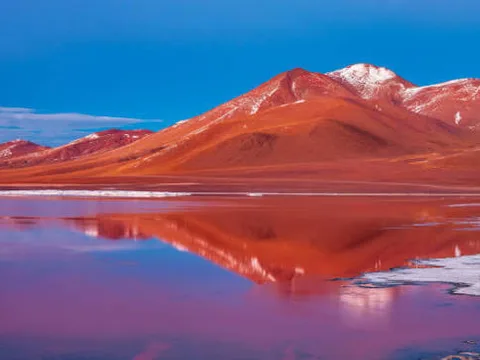
These are not a short version and a long version of the same trip. They are two different landscapes, and the choice usually comes down to one question: do you want the salt flat, or do you want the coloured lagoons behind it?
What the one-day tour covers
The salt flat itself, without rushing it. You leave Uyuni at 10:30 and stop at the train cemetery, the salt-processing village of Colchani, the ojos de sal, the Dakar monument and the salt hotel, then spend the afternoon out on the white for the perspective photographs, Incahuasi Island and sunset. Back in Uyuni between 19:00 and 20:00. From $79 per person in a shared 4x4.
What the three-day tour adds
Day one is essentially the tour above, ending with dinner and a night in a salt hotel in Colcha K. Then the route turns south into the Eduardo Avaroa reserve, and this is where the trip stops being about salt. Day two is the Ollagüe volcano viewpoint, Lagunas Cañapa, Hedionda and Honda with their flamingo colonies, the Siloli desert, the Árbol de Piedra, the red Laguna Colorada, the Sol de Mañana geysers and an evening soak in the Polques hot springs, where you spend the night. Day three is the Dalí desert, the emerald Laguna Verde, then the long way home through Villamar, the Valle de Rocas and San Cristóbal.
| 1 day | 3 days | |
|---|---|---|
| From (shared, per person) | $79 | $239 |
| Salt flat & Incahuasi | Yes | Yes |
| Coloured lagoons & flamingos | No | Yes |
| Geysers & hot springs | No | Yes |
| Highest point | 3,656 m | ≈ 4,850 m |
| Nights on the road | None | 2 |
| Can end in Chile | No | Yes |
The part people underestimate: the cold
The second night is spent in a simple shared lodge by the Polques hot springs, above 4,000 m, and it is basic: six to a room, no heating. In the dry season, outside temperatures overnight regularly fall to −10 °C and below. Beds and blankets are provided; bring thermal layers, a hat and gloves, and most travellers who skip them regret it.
This is a real filter. If the idea of a freezing dormitory at 4,300 m sounds miserable rather than adventurous, the one-day tour is not a lesser choice — it is the right one.
So which one?
- Choose one day if your schedule is tight, if the mirror or the white horizon is what you came for, or if sleeping at altitude worries you.
- Choose three days if you want the reds, greens and flamingos — none of which are on the salar. They are three hundred kilometres further south.
- Choose three days if you are heading to Chile. The route can drop you at the Hito Cajón border for San Pedro de Atacama instead of returning to Uyuni.
Both tours run shared, up to six travellers, or as a private 4x4 for up to four. Private costs more but buys you the pace — stopping where you want, for as long as the light is good.
Frequently asked questions
- Is one day enough to see the Uyuni salt flats?
- Yes, for the salt flat itself. The one-day tour covers the train cemetery, Colchani, the salt hotel, Incahuasi Island and sunset without rushing. It does not reach the coloured lagoons or the geysers.
- How cold does it get on the 3-day tour?
- The second night is above 4,000 m in an unheated refuge. In the dry season, overnight temperatures regularly drop to −10 °C or below. Beds and blankets are provided; thermal layers, a hat and gloves are strongly recommended.
- Can I travel from Uyuni to San Pedro de Atacama on the tour?
- Yes, on the three-day tour. On the final morning you can transfer at 09:00 to the Hito Cajón border instead of returning to Uyuni. The onward bus ticket costs 200 BOB and is not included.
- What is the price difference between the 1-day and 3-day tours?
- Shared departures start at $79 per person for one day and $239 for three days, which includes all meals and two nights of accommodation. A private 4x4 for up to four travellers is $319 and $1,290 respectively.