Places
Uyuni train cemetery: history, visiting tips and Colchani
· 6 min read
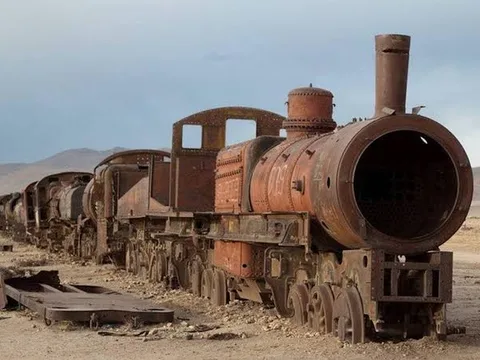
The Uyuni train cemetery (Cementerio de Trenes) is a yard of rusting steam locomotives about 3 km south-west of the town, abandoned as the region’s mining traffic collapsed in the 1940s. It is an open site with no visitor centre, and most salt flats tours stop there first before heading 22 km north to the salt village of Colchani.
Where is the train cemetery, and how do you get there?
The yard lies about 3 km south-west of Uyuni’s railway station, out along Avenida Ferroviaria, roughly ten minutes by car. You can walk it in about half an hour, but the road out of town is not one to walk back along alone after dark; a taxi from the centre is the easy alternative.
There is no visitor centre and there are no information panels. It is a stretch of desert with dozens of engines and wagons left more or less where they stopped, which makes it free of formality and short on explanation. That is what the next section is for.
Why are there abandoned trains in Uyuni?
Uyuni was founded in 1890 as a trading post on the railway that British engineers built across the region between 1888 and 1892 for the Antofagasta and Bolivia Railway. The line carried minerals from the Bolivian highlands down to the Pacific at Antofagasta, a port Bolivia had lost to Chile in the War of the Pacific of 1879 to 1884. Uyuni became a junction, and it still is: the lines from Oruro and La Paz, from Calama in Chile, from Potosí and from Villazón on the Argentine border all meet here.
When mining in the region collapsed in the 1940s, partly because the deposits were running out, the traffic went with it. Locomotives sent to Uyuni for repair were never put back into service, and the yard on the edge of town became their last stop. Most of the engines are early 20th-century British steam locomotives. Decades of salty wind have done the rest, and many were stripped for parts long ago.
The railway itself never closed. Uyuni is still a railway town, and passenger trains from Oruro, the Expreso del Sur and the Wara Wara del Sur, arrive a few days a week after a journey of roughly seven hours before continuing south towards the Argentine border. Arriving by train, past the same yards the dead engines once worked, is the most fitting way to reach the cemetery, and how to get to Uyuni compares it with the bus and the plane.
What is there to see?
Dozens of engines and carriages in a loose line across the sand, boilers split open, cabs rusted through, a few covered in graffiti. People climb on and into them, and the low light at either end of the day turns the rust a deep orange against the pale desert and the hills behind.
Be careful if you climb. The metal is sharp and rusted, floors give way, and nobody is there to help if you fall. Keep children close, and make sure tetanus jabs are up to date before you travel.
How to photograph the train cemetery
- Shoot along the line of engines with a wide lens, so the locomotives recede one behind the other into the desert.
- Get low and put a boiler against the sky; the rust reads best on a deep blue background.
- Use people for scale. Someone sitting on a cab roof shows how big these machines are better than any caption.
- Avoid midday if you can. The hard overhead light that suits the salar flattens rusted metal, while the first and last hours give it texture.
When is the best time to visit?
Early morning or late afternoon. The site is busiest in the late morning, because it is the first stop for tours leaving Uyuni; on both of our tours it comes right after the 10:30 departure. If you want it quieter, or want photographs in low light, go independently at sunrise or sunset the day before your tour and treat the tour stop as a second look.
One practical note on drones: the cemetery lies within 9 km of Uyuni’s airport, where Bolivian rules require prior authorisation for hobby flights, if they are allowed at all. Our perspective photo guide sets out the 2026 drone rules.
Colchani: the salt village
About 22 km north of Uyuni, right on the edge of the salar, Colchani is where the salt is worked. It is a village of around 600 people whose cooperative digs salt from the crust, dries it, adds iodine, grinds it and packs it into one-kilogram bags for sale in Bolivia and Brazil. The scale is modest: the salar holds an estimated 10 billion tonnes of salt, and less than 25,000 tonnes a year are taken out.
On our tours the stop is the salt-processing museum and the workshops around it: heaps of salt drying on the flat, the ovens and the bagging, with souvenir stalls along the street. It is the last village before the salar opens up.
After Colchani: the first stops on the salt
From Colchani the tours drive out onto the crust. The next stops, all on our itinerary, are the ojos de sal, where water wells up through holes in the salt; the Dakar monument, a salt sculpture marking the rally’s first crossing of Bolivia in 2014; the salt hotel at Playa Blanca, which is the lunch stop on the 3-day tour; and the monument of flags from many countries. Then the salar opens out for the perspective photographs, Incahuasi Island and sunset.
All of this is on the 1-day tour, which leaves at 10:30 and returns after sunset, and on the first day of the 3-day tour. The 1-day tour costs $79 per person in a shared 4x4, in 2026 as in 2027, and the only entrance fee not included is 30 BOB for Incahuasi Island. If you are deciding between the two, 1 day or 3 days sets out the difference. Seats are confirmed as soon as you book online.
Frequently asked questions
- How far is the train cemetery from Uyuni?
- About 3 km south-west of the town’s railway station, roughly ten minutes by car or half an hour on foot. Do not walk back alone after dark.
- Can you visit the Uyuni train cemetery without a tour?
- Yes. It is an open site; take a taxi or walk out from town. Going at sunrise or in the late afternoon also avoids the late-morning crowds, when most tours stop there.
- Why are there abandoned trains in Uyuni?
- Uyuni grew up as a junction on the railway that carried minerals to the Pacific. When mining in the region collapsed in the 1940s, locomotives sent to Uyuni were left there for good. Most of the engines that remain are early 20th-century British steam locomotives.
- Is the train cemetery included in the 1-day Uyuni tour?
- Yes. On both our 1-day and 3-day tours it is the first stop after the 10:30 departure, followed by the salt village of Colchani.
- How far is Colchani from Uyuni?
- About 22 km north, on the edge of the salar. It is the village where salt from the salar is dried, iodised and packed, and on our tours the stop after the train cemetery.