Families
Uyuni with kids: is the salt flats tour right for children?
· 6 min read
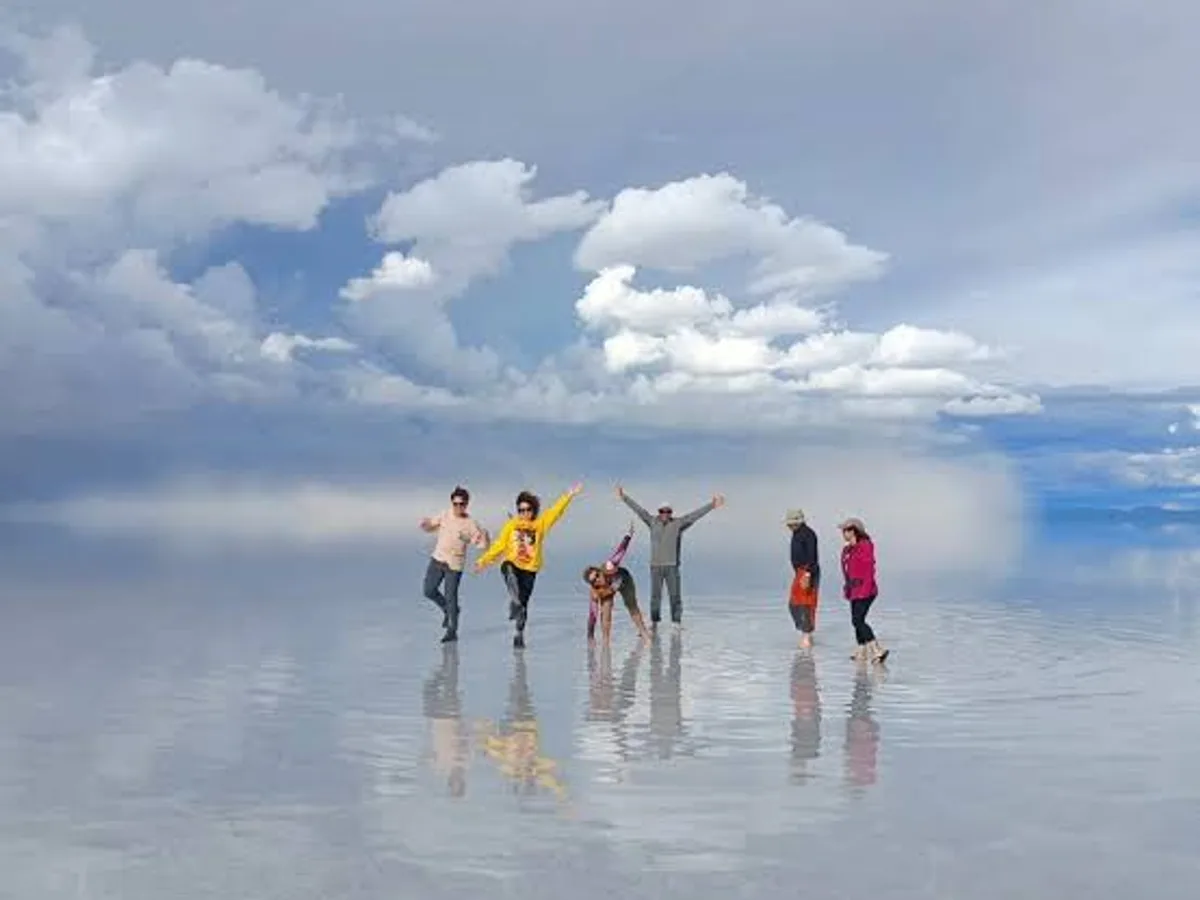
Yes, children can do a Uyuni salt flats tour. The 1-day tour suits families best: it stays at about 3,660 m and you sleep in town. The 3-day route climbs close to 5,000 m and spends a cold night above 4,000 m, a much bigger ask for young children. Babies under six weeks should not go at all.
Is the altitude safe for children?
Children react to altitude much as adults do. The travel health guidance of the US Centers for Disease Control (CDC) says children are as susceptible to altitude illness as adults, and lists infants under six weeks old among those who should not ascend. The difficulty with small children is noticing: a toddler cannot tell you about a headache. In children too young to talk, the CDC lists loss of appetite, irritability and pallor as the signs, and symptoms usually appear 2 to 12 hours after arriving higher, often during or after the first night.
Everything in Uyuni is high. The town sits at about 3,670 m, so even the 1-day tour is a trip to altitude, and every night there is a night at altitude. The CDC advises gaining height gradually: once above 3,000 m, raise the altitude you sleep at by no more than 500 m a day. Arriving from La Paz, at 3,640 m, changes little; arriving from the coast or the lowlands means at least one night in Uyuni, La Paz or Potosí before the tour, and two with children. Talk to your paediatrician before you book, especially if your child has a heart or lung condition, and ask them about medication. Our altitude guide covers the rest.
The 1-day or the 3-day tour with children?
| 1-day tour | 3-day tour | |
|---|---|---|
| Highest point | The salt flat, ≈ 3,660 m | Close to 5,000 m at the Sol de Mañana geysers |
| Nights | Your own hotel in Uyuni | Salt hotel in Colcha K, then a basic shared lodge at ≈ 4,400 m |
| Time in the vehicle | 10:30 to about 19:00 or 20:00, with many stops | Three long days; day two is the biggest driving day |
| Cold | Cool by sunset; a warm jacket is enough | Night two is basic and cold, well below freezing from April to October |
| Shared, per person (2026) | $79 | $239 |
| Private, whole vehicle (2026) | $319 | $1,290 |
For most families the 1-day tour is the right answer, and it is not a lesser trip: it covers the train cemetery, the salt workshops of Colchani, the perspective photographs, Incahuasi Island and sunset on the salt. The 3-day tour suits older children and teenagers who cope with long drives, early starts and a basic, freezing night. A fair rule of thumb is to wait until a child can tell you clearly when they feel unwell. Our 1 day or 3 days comparison goes through the rest.
Private or shared 4x4 for a family?
A private vehicle makes most sense for families. You set the pace, stop when someone needs a toilet or a break from the car, and leave the photo stop when the youngest has had enough. On our tours a private 4x4 takes up to four travellers for one flat price, and there is no separate child rate: each child counts as one traveller. For a family of four on the 1-day tour in 2026, a shared departure costs 4 × $79 = $316 and a private vehicle $319, practically the same price. On the 3-day tour it is $956 shared against $1,290 private. From 1 January 2027 the 1-day figures do not change, and the 3-day ones become $1,076 against $1,420.
An English-speaking guide adds $20 per person on a shared 1-day tour, or $110 for the whole private vehicle. A family of five or more is over the four-seat limit of a private vehicle and needs a shared departure, which carries up to six. Do not assume a child seat will be available: if your child needs one, write to us before booking. When you are ready, you can check dates and book online.
What children enjoy most
- The perspective photographs. A toy dinosaur and a lens at ground level turn the salar into a film set, and our guide to perspective photos has the tricks.
- The train cemetery, a yard of rusting steam engines just outside town. Watch for sharp edges and rusty metal, and check that tetanus jabs are up to date.
- Incahuasi Island, with its giant cacti and a short trail up the rock, when the salar is dry enough to reach it.
- On the 3-day tour: flamingos on the lagoons, the steaming Sol de Mañana geysers and an evening soak in the Polques hot springs. Keep children well back from the geyser vents and the boiling mud.
Keeping children warm, fed and comfortable
- Layers, not one big coat. Days on the salar reach 13 to 21 °C depending on the month, and nights in town drop below freezing from April to October; the weather month by month has the figures.
- Sunscreen, sunglasses that fit and a hat with a brim. Children’s skin burns quickly at 3,660 m, and the white salt reflects the light back up from below.
- Water and snacks. Lunch and a sunset snack are included on the 1-day tour, and every meal on the 3-day tour, but the gaps between stops are long.
- Toilet paper and hand gel. Facilities on the route are basic, which is why toilet paper is on our what-to-bring list.
- Something for the drive, downloaded before you leave, and a power bank. Phone signal fades fast once you are out of town.
- Rubber boots are provided on our tours in the rainy season; for small children, bringing a pair from home is the safer bet.
Warning signs to act on
A mild headache and a restless first night are common at altitude, in children as in adults. Tell the driver-guide at once, and plan to go down, if a child vomits repeatedly, becomes unusually drowsy or confused, struggles to breathe at rest, or stops eating and playing in a way that worries you. On the 1-day tour, Uyuni is never more than a few hours away. Deep in the reserve on the 3-day route, help is much further off, which is the strongest argument for keeping young children to the salar.
Frequently asked questions
- What is the minimum age for a Uyuni tour?
- The limit that matters is medical. The CDC lists infants under six weeks among those who should not go to high altitude, and says children of any age are as susceptible to altitude illness as adults. Discuss any young child with a paediatrician before booking, and favour the 1-day tour for preschoolers.
- Is the 3-day Uyuni tour suitable for children?
- For older children and teenagers who cope with long drives and cold, yes. It climbs close to 5,000 m and the second night, at about 4,400 m, is basic and cold, so for young children the 1-day tour is the better choice.
- Do children pay less on Uyuni tours?
- Not on ours: each child counts as one traveller. A private 4x4 is one flat price for up to four travellers, $319 for the 1-day tour and $1,290 for the 3-day tour in 2026. On the 1-day tour that is about what four shared seats cost.
- Can you take a baby to the Uyuni salt flats?
- Not a newborn: the CDC advises that infants under six weeks old should not go to high altitude. For older babies, talk to a paediatrician first, since a baby cannot tell you how it feels and the signs of altitude sickness are easy to miss.
- What should children bring on a Uyuni tour?
- Warm layers, a hat, gloves, sunscreen, sunglasses that fit, snacks, water and something to do in the car. In the rainy season, boots for small feet are worth bringing from home.